

“Friday The Thirteenth” is a phrase that has been used to illustrate bad luck for many, many years. Books and been written and films have been made on the subject, but for us, “Friday the 13th” only means our Halifax Bomber, residing in the main hangar.
Many visitors are suprised by the physical size of the bomber and also, how few of them now survive. So here are some interesting facts about “Friday the 13th” and the Handley Page Halifax in general that you may not realise when you visit us.
How “Friday the 13th” got her name
We’ve written before about how the original Halifax Friday the 13th was named, you can read a full account here. Briefly, after a series of losses of Halifax aircrew from No. 158 Squadron based at RAF Lissett near Bridlington, all flying on bombers carrying “F” for “Freddie” identity, aircrew were coming to dread being assigned that aircraft. At the time, aircrew life expectancy was incredibly short and with the randomness of life or death preying on the minds of the young aircrews, superstition was inevitable.
To kill the myth, the next replacement “F” for “Freddie” was named “Friday the 13th” and carried an inverted horseshoe and a grim reaper symbol, all intended to challenge and thus remove, the myth of bad luck.
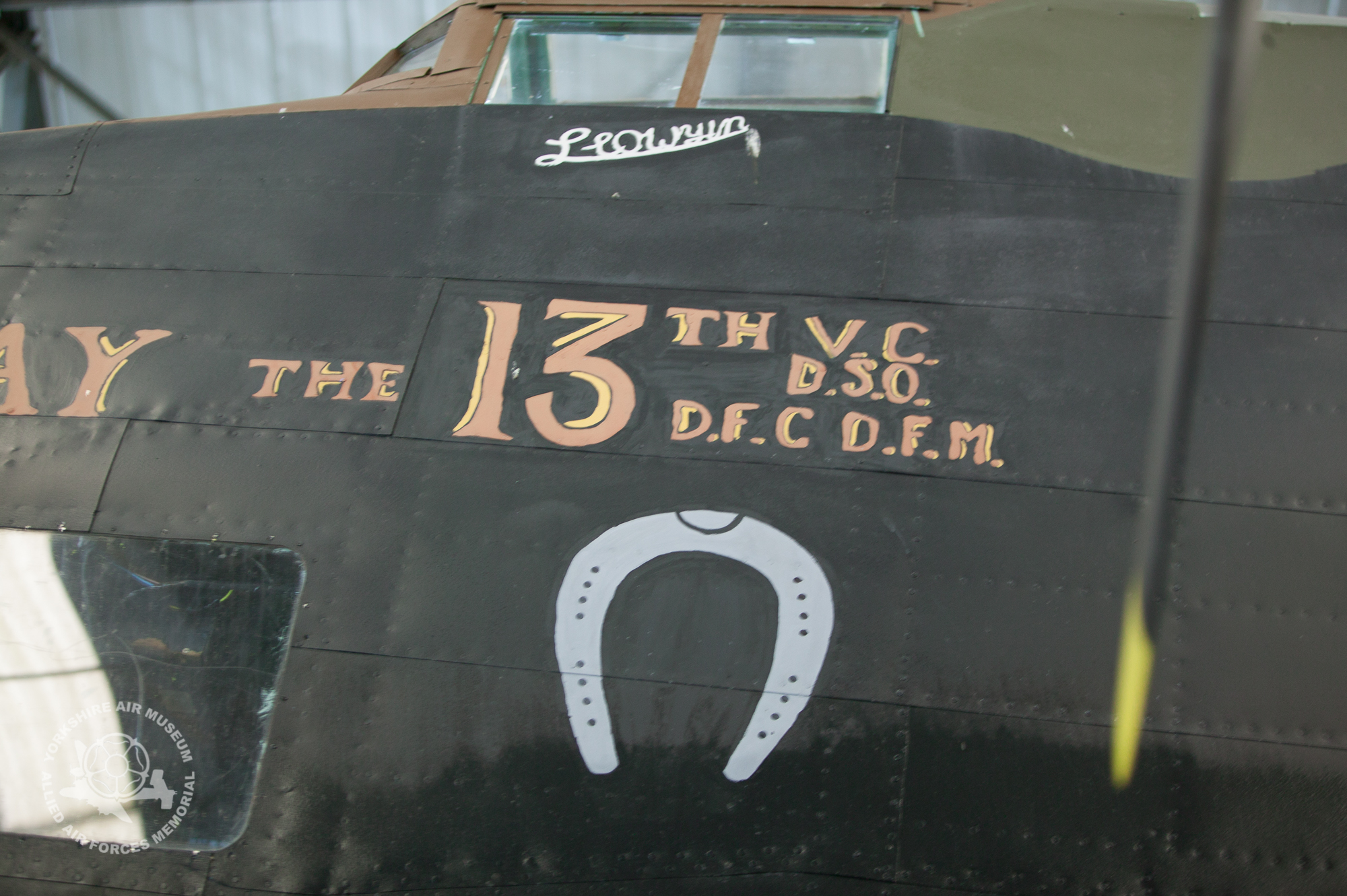
What the Halifax artwork means
The bomb symbols are obviously records of missions with the yellow bombs indicating night-time raids and the white bombs , daylight missions. The inverted horseshoe, skull and crossbones and grim reaper are there to confront the myth of bad luck. It worked, as “Friday the 13th” became one of the luckiest aircraft of the war, completing a record 128 missions. Reputedly the largest number of missions of any bomber, Axis or Allied.
Ours is not the original Friday the 13th
Our Halifax was created over many years by a team of volunteers using components and sub assemblies from various original Halifax aircraft. Brought together and restored by the Museum over 20 years, our final Halifax is a faithful recreation of the Halifax bomber both inside and out. We chose to commemorate “Friday the 13th” as the aircraft which was the most famous and certainly the most successful Halifax bomber of World War Two.
What happened to the original?
In 1945, following the end of the War in Europe, “Friday the 13th” was chosen to represent RAF Bomber Command and installed amidst the bomb damage in Central London. It took pride of place at a special exhibition in Oxford Street (see picture).
As the late Squadron Leader “Bluey” Mottishead DFC of 158 Squadron said, “then, without a thought to future generations, “Friday the 13th” was scrapped“.
“Friday the 13th” was scrapped not far from the Museum at York Aircraft Repair Depot, Clifton Airfield. Despite flying 128 missions and bringing back her crew safely, there was precious little sentiment for many aircraft at the end of the war. Their aluminium was desperately need to build pre-fabricated housing to replace the thousands of homes destroyed during the Blitz. “Swords into ploughshares” could not be a truer statement. Today, such an achievement would ensure that at least one aircraft like this would survive, but at that time, people were glad to see the end of the long conflict and scrap alloy was of more value than sentiment.

How our Friday 13th was built
Work commenced on the project almost at the beginning of the Museum’s establishment back in 1986. A long project, work was finally completed externally in 1996 when it was rolled out to the delight of hundreds of veterans who had not seen one since 1945. Today, the Halifax is maintained and cared for by our volunteer Aircraft Engineering team, enabling her to be rolled outside on some occasions, while work to enhance the already very accurate interior continues.
You can tour the Halifax yourself.
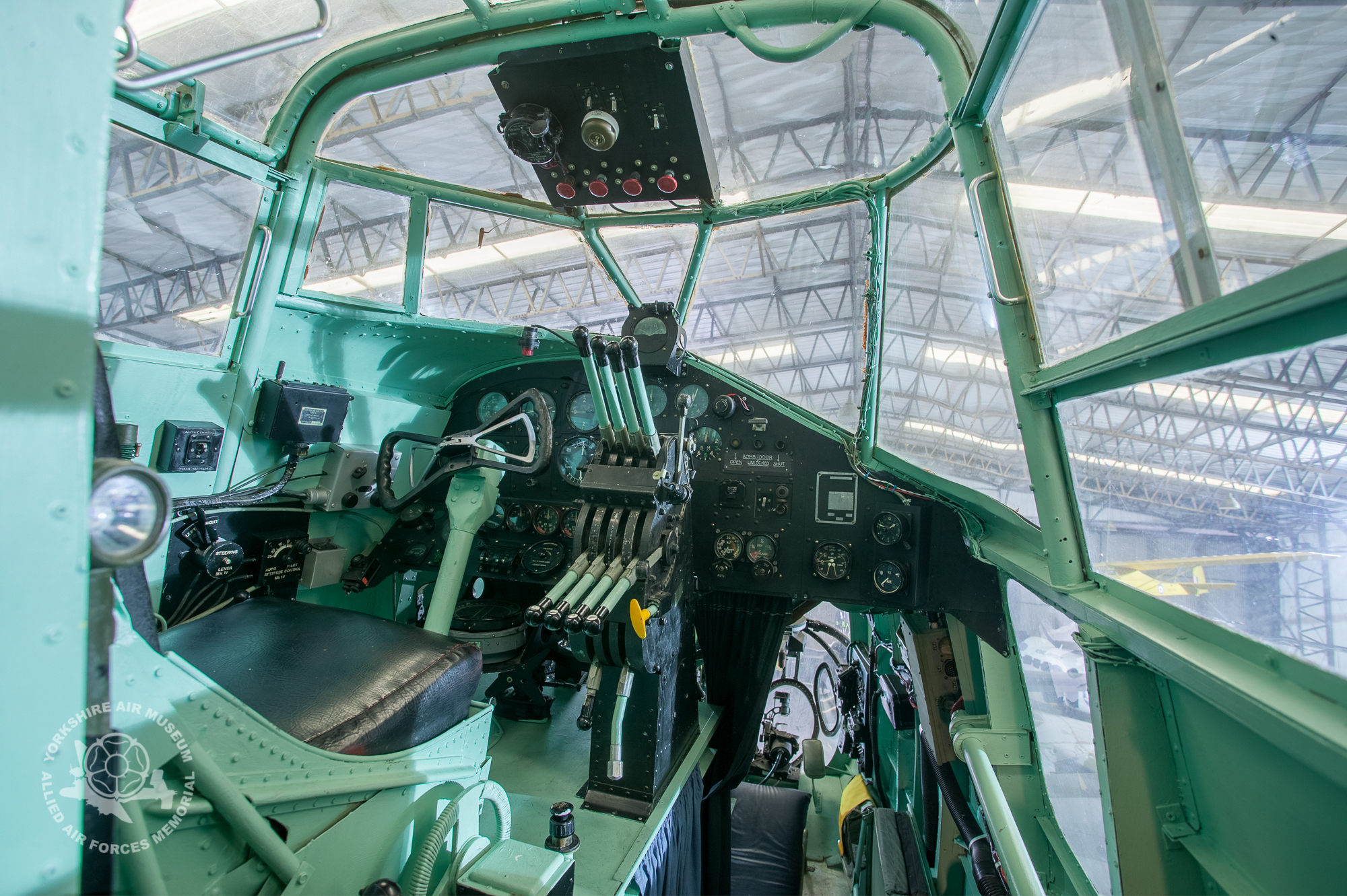
Many people don’t realise that you can take a tour inside our Halifax yourself. Our Halifax Sponsorship program gives you the opportunity to spend some time inside the aircraft with a guide and enjoy a full tour of her interior. It’s only when you see for yourself the conditions endured by the aircrews that you can begin to understand the sacrifice and what they must have been thinking on each evening’s mission.
Surviving aircrew and their direct descendants qualify for a special rate, contact us for details. If you cannot get to the Museum in person, you can enjoy a 360VR tour of the Halifax here.
She carries French Air Force markings on one side
Many visitors miss the fact that our Halifax has the markings of LV907, “Friday the 13th” from No. 158 Squadron RAF on the port side, while she carries French Air Force markings of N – Novembre” of 346 “Guyenne” Squadron on the opposite side. This is to commemorate the two French bomber squadrons that uniquely served at RAF Elvington during the war.

Where you will find her at the Museum
The Halifax lives inside our main hangar, surrounded by other aircraft exhibits that need protection from the elements. On certain occasions, she is moved outside for visitors to see outdoors. Inside the hangar, you can walk right up to her and experience for yourself the physical size of these old heavy bombers.
Other Halifax aircraft remaining
More than 6,000 Halifax aircraft were built. Today just a handful remain. None are airworthy and there are just two fully complete examples, ours and a transport version in Canada. The Imperial War Museum has a section that was rescued and restored, while the RAF Museum in Hendon houses Halifax “S” for Sugar” on display exactly as it was recovered from a Fjord in Norway.
For some visitors, the Halifax is the prime motivation for coming to the Museum, while others are amazed to see such a large aircraft standing majestically in the hangar.
For us, our Halifax is not just “Friday the 13th”. Far from being unlucky, she serves as a centre-piece of the Museum’s Allied Air Force Memorial to commemorate the wide ranging nationalities of the aircrews that served here in World War Two, many of whom never returned to their home nations.
Representing over 50% of the total force, 58,000 RAF Bomber Command aircrew died in action, often in horrific circumstances. The highest casualty rate of any service arm, Allied or Axis, during World War Two.
They were all volunteers.