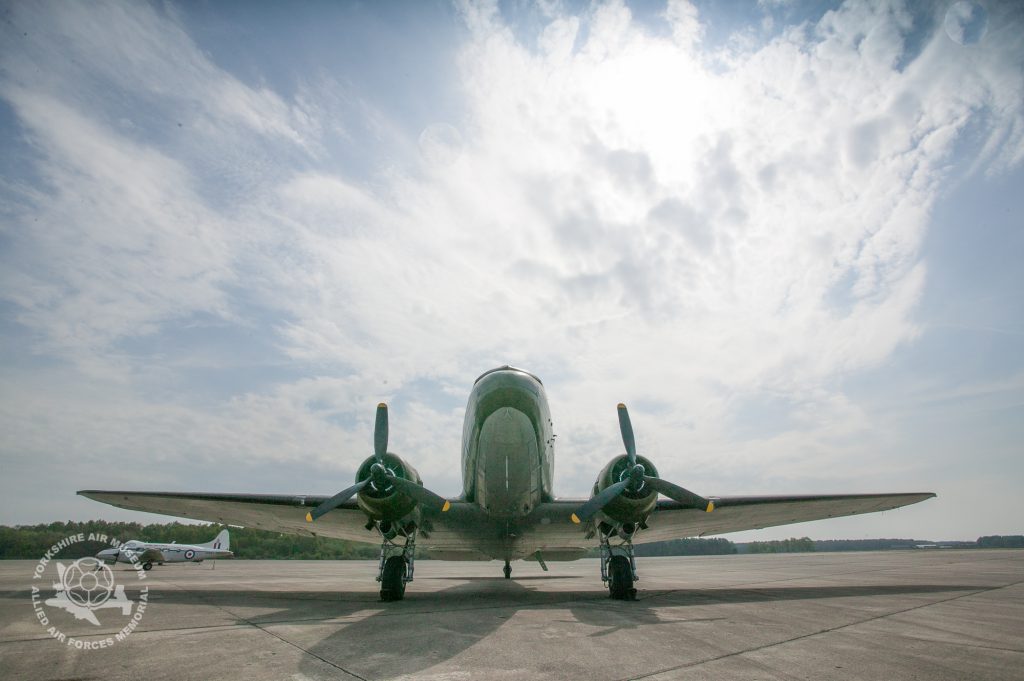
Dakota Taxiing in the Sunshine

Saturday saw our Dakota taxi testing out on the wide expanses of Elvington airfield. A relatively low key event, the day was planned to test further the reliability of the Wasp engines following our winter overhaul work. It’s one thing to be running stationary on a Thunder day, but another altogether to have her taxiing under her own steam for the first time in quite a while.

Dakota out on the vast expanse of Elvington's airfield
Dakota out on the vast expanse of Elvington’s airfield

Our Devon has also been showing promise, so our volunteer engineering team decided to run her too. Sadly, she reverted back to her old habits, with fuelling issues returning unexpectedly, despite behaving perfectly at the recent Thunder day!

The tests went very well. While the Dakota is still not quite perfect, it did highlight the few remaining faults, mainlŷ ignition related. Just like old racing cars, it’s only when you run these old engines for real that the truth is known. With us for the day to train our staff on handling techniques was Dakota pilot and engineer Mark Edwards. Mark proved invaluable, his Dakota flying experience allowed us to quickly track down elusive symptoms and using his experience, the team identified the remaining snags.

Dakota on the runway - photo Ian Finch
Dakota on the runway – photo Ian Finch

Joining us mid afternoon was a pretty Piper Cub, complete with period D Day invasion stripes. The three old aircraft made quite a picturesque sight sitting in the Yorkshire sunshine.

Piper Cub called in for coffee and cake

It was great to see the old Dakota moving under her own steam, not resting against the chocks as the engines ran up. On the second run, Mark, with Andre Tempest in the co pilot seat and Graham Sharpe on board as engineer, ventured gently out onto the runway, the vast length of Elvington’s tarmac before them. A gentle run along part of it was a nice bonus after the hard work over winter.

Resting in between taxi runs and enjoying the wide open spaces

Several visitors asked why we were doing this. Quite simply, just like old classic cars, these aircraft can suffer from ‘standing-itis’. Long periods of inactivity can develop faults, even on modern military jets. The more frequently they run, the more reliable these old aircraft actuallŷ become.

Devon decided to be grumpy and run just one engine.

It’s hoped that by running the Dakota and others regularly we will help keep them fit. And as they enjoy the excercise, so more visitors will be able to enjoy the sight and sound of these big radial engines.

The inevitable question was also, “will we ever carrŷ passengers?” That’s something that has a whole list of hurdles to overcome in this modern age, perhaps a discussion for another time.

Clipped wing Spitfire flypast in the afternoon
Clipped wing Spitfire flypast in the afternoon photo via Ian Finch

The final query was, “what happened to the BBMF?” Well, their Dakota decided that it would go unserviceable on Saturday. Proof that perhaps even a team of Royal Air Force engineers can’t make these old ladies run if they don’t want to…. The consolation prize, however, was a Spitfire flyby late in the afternoon. A Merlin is always a nice way to finish the day.

Piper Cub sitting in the sunshine. A lovely day to be with some vintage aeroplanes.
Sunbathing...
Sunbathing…

If you are a journalist and require more info about this story don’t hesitate to email pr@yorkshireairmuseum.org

Blackburn Mercury Monoplane 1911 (Replica) AH (BAPC) 130 YAM Jan.1995

The Blackburn Mercury Monoplane is regarded as the first truly successful aircraft made by Blackburn at their factory in Leeds. The Mercury I, powered by a 50 hp Isaacson radial engine, was displayed at the Olympia Aero Show in March 1911 and made its debut flying from the beach at Filey with the newly formed Blackburn Flying School. In May 1911, it flew from Filey to Scarborough and back in 19 minutes at an average speed of 50 mph, reaching an altitude of 1200 feet.
This aircraft crashed the next day when the engine seized and the propeller flew off! The Mercury I was followed by two Mercury II aircraft powered by 50 hp Gnome engines, and six Mercury III aircraft, with a number of different engines. Sadly, a Renault powered Mercury crashed at Filey in December 1911, killing an instructor and passenger.
The Museum’s replica was built for Yorkshire Television in 1979 for the Edwardian drama series ‘Flambards’, and was taxied with a car engine. It came to YAM on 10th January 1995 and after a long period in storage it was painstakingly restored to a superb display standard, and was unveiled in June 2000 by Professor Robert Blackburn, grandson of Robert Blackburn, the aviation pioneer.

AVRO 504K ‘H1968’ (Replica) AH (BAPC) 42 YAM Oct. 1994

The Avro 504 first flew in 1913. In the opening phases of the First World War, it served with front-line squadrons in the Royal Flying Corps and Royal Naval Air Service for bombing and reconnaissance, but from 1915 onwards the aircraft entered the training role for which it is most celebrated.

Over 8,000 Avro 504s were built. In 1918, the Royal Air Force had about 3,000, of which 2,276 were trainers.

The Avro 504 was stationed at many Yorkshire airfields, including Tadcaster near the A1/A64 junction, where a period hangar can still be seen.

The Yorkshire Air Museum’s replica was built by apprentices at RAF Halton and appeared at the Royal Tournament in 1968 to commemorate what was then fifty years since the end of the First World War. The aircraft was refurbished in early 2015 to be transported to Thiepval, Northern France, for the Somme Centenary commemoration event, on request of the British Government. In May 2018, it was also displayed at the impressive Hotel Les Invalides in central Paris for a joint RAF / French Air Force event to mark the Centenary of the Royal Air Force and over 100 years of British and French Air Force collaboration.