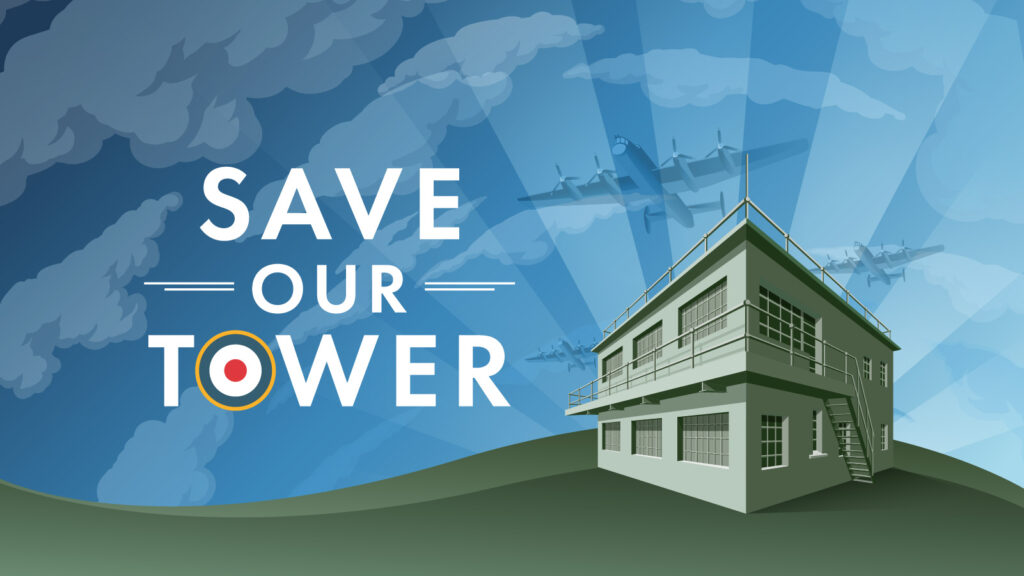
Save our tower appeal

Yorkshire Air Museum Launches Save Our Tower Appeal

A fund-raising campaign has begun to help with the restoration of a Grade 2 Listed World War Two Control Tower which witnessed hundreds of allied bombing raids over occupied Europe and Nazi Germany.

The Tower at the Yorkshire Air Museum – formerly RAF Elvington – is one of the last of its kind still standing but it needs its windows and external rendering replacing. The museum is looking to raise £100,000 towards the cost of the work.

This building was the eyes and ears of operations against Nazi Germany. From behind its windows, RAF personnel watched thousands of Halifax bombers take to the skies. Almost half would not return from their missions. It stands as a living memorial to the bravery and sacrifice of RAF Bomber Command.

The tower is at the centre of the museum, which is also the Allied Air Force Memorial. It was saved from dereliction 40 years ago and now is in need of further vital restoration to preserve it for the future.

The work is being carried out by specialist builders and engineers at a total cost of around two hundred thousand pounds.

Chair of Trustees, and founder of the museum, Rachel Semlyen MBE, said:

“In the 1980s we rescued the tower and the site to create a museum and memorial. During lockdown we had a survey of the Tower and it was found to be leaking badly. Earlier this year we repaired the roof, the rusted iron balustrade, the gutters and the staircases. But now to complete this specialist restoration work and prevent further decay, we need to find more than £200,000 – of which the museum has only half.”

Yorkshire Air Museum is now launching the Save Our Tower fundraiser, to coincide with the first bombing missions from the former airbase in 1943. The public can donate online or in person at the museum and a serious of special events are planned for 2023.

Further Notes:

Out of 4,000 sorties made from RAF Elvington, almost half of all the aircrews involved (more than 700 young men) were killed or made prisoners of war. They came from the UK, Canada, Australia and New Zealand, as well as from France, with two bomber squadrons of the Free French Air Force being stationed at Elvington in the last year of the war. The base closed after the war and was abandoned. The runway was extended for use by US Air Force bombers but they never arrived.

For more information and to donate: https://yorkshireairmuseum.org/control-tower/save-our-tower/

If you are a journalist and require more info about this story don’t hesitate to email pr@yorkshireairmuseum.org

Blackburn Mercury Monoplane 1911 (Replica) AH (BAPC) 130 YAM Jan.1995

The Blackburn Mercury Monoplane is regarded as the first truly successful aircraft made by Blackburn at their factory in Leeds. The Mercury I, powered by a 50 hp Isaacson radial engine, was displayed at the Olympia Aero Show in March 1911 and made its debut flying from the beach at Filey with the newly formed Blackburn Flying School. In May 1911, it flew from Filey to Scarborough and back in 19 minutes at an average speed of 50 mph, reaching an altitude of 1200 feet.
This aircraft crashed the next day when the engine seized and the propeller flew off! The Mercury I was followed by two Mercury II aircraft powered by 50 hp Gnome engines, and six Mercury III aircraft, with a number of different engines. Sadly, a Renault powered Mercury crashed at Filey in December 1911, killing an instructor and passenger.
The Museum’s replica was built for Yorkshire Television in 1979 for the Edwardian drama series ‘Flambards’, and was taxied with a car engine. It came to YAM on 10th January 1995 and after a long period in storage it was painstakingly restored to a superb display standard, and was unveiled in June 2000 by Professor Robert Blackburn, grandson of Robert Blackburn, the aviation pioneer.

AVRO 504K ‘H1968’ (Replica) AH (BAPC) 42 YAM Oct. 1994

The Avro 504 first flew in 1913. In the opening phases of the First World War, it served with front-line squadrons in the Royal Flying Corps and Royal Naval Air Service for bombing and reconnaissance, but from 1915 onwards the aircraft entered the training role for which it is most celebrated.

Over 8,000 Avro 504s were built. In 1918, the Royal Air Force had about 3,000, of which 2,276 were trainers.

The Avro 504 was stationed at many Yorkshire airfields, including Tadcaster near the A1/A64 junction, where a period hangar can still be seen.

The Yorkshire Air Museum’s replica was built by apprentices at RAF Halton and appeared at the Royal Tournament in 1968 to commemorate what was then fifty years since the end of the First World War. The aircraft was refurbished in early 2015 to be transported to Thiepval, Northern France, for the Somme Centenary commemoration event, on request of the British Government. In May 2018, it was also displayed at the impressive Hotel Les Invalides in central Paris for a joint RAF / French Air Force event to mark the Centenary of the Royal Air Force and over 100 years of British and French Air Force collaboration.