
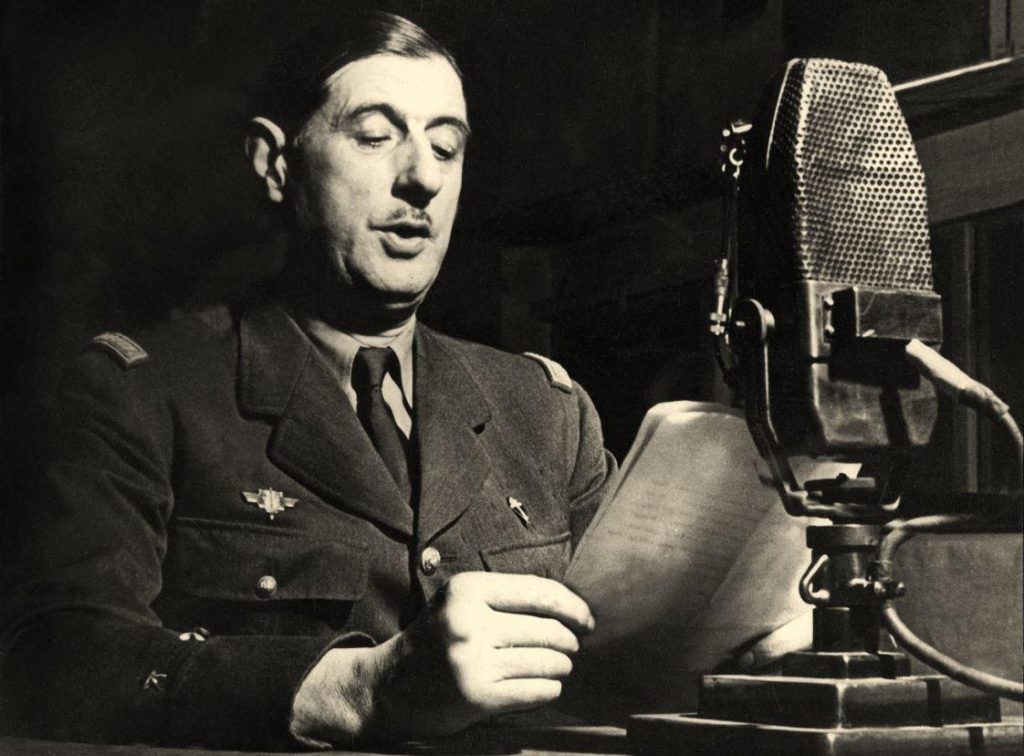
18th June 1940 – l’Appel
18th June marks the day, 81 years ago, when Charles De Gaulle delivered his famous speech from London to rally the French people to the resistance movement. This speech is known by the French as l’Appel (‘the call’).
Across the Channel, thousands of French people heard his voice for the first time, and listened to a message of hope and courage. A new movement was born: Free France.
The origins of the Call
In May 1940, before the Battle of Britain, the Germans started their offensive in the west. After The Netherlands and Belgium fell, Panzer divisions broke through the Ardennes causing a massive exodus of civilian populations from the North.
In France, clashes erupted among the civil and military leaders. There were two distinct conflicting camps with some people wanting to continue to fight while others supported an armistice with Germany. On 16th June 1940, Maréchal Pétain was nominated to form a new ministry. For the French, 84 year old Maréchal Petain was a national treasure, a First World War hero. His appointment created a sense of general elation with renewed hope that France would be saved and would vanquish its enemy.
On 17th June, everyone in France was awaiting Petain’s speech with trepidation.
Maréchal Petain addressed the nation in a quavering voice:
“It is with a heavy heart that I’m telling you today that we must stop the fight.”
The “hero of Verdun” considered the French army defeated and asked for an armistice with Germany.

Maréchal Pétain, 17th June 1940
Général De Gaulle
At the time, the relatively unknown Général de Gaulle was listening intently.
Aged 49, Charles de Gaulle had repeatedly illustrated himself during the Nazi Germany invasion of France. Notably, he had managed to stop the Germans in Abbeville while heading a tank division (27-30th May, 1940). De Gaulle was appointed General on 1st June and, a few days later, Under-Secretary of State for Defense and War.
De Gaulle heard Maréchal Pétain’s request for an armistice and could not bear it. He immediately left for London with the sole purpose of continuing the fight. For him, Churchill was a natural ally, one who would never surrender.
In London, all those who wanted to resist Hitler assembled around Churchill: the Czechs, Poles, Norwegians, Dutch, Belgians and, now, the French.
18th JUNE 1940
Churchill seeing de Gaulle as a man of destiny consulted the members of the war cabinet to allow de Gaulle to speak on the BBC airwaves on 18th June.
The same day Churchill delivered his ‘Finest Hour’ speech, De Gaulle’s voice crossed the seas and oceans to address the French people and call for resistance. His speech would become History.
To this day, ‘L’appel’ of 18th June 1940 is considered the founding text of the French Resistance, of which it remains the symbol.

“Whatever happens, the flame of French resistance must not and will not be extinguished!”
“Quoiqu’il arrive, la flamme de la resistance française ne doit pas s’éteindre et ne s’éteindra pas!”
(extract from l’Appel by Général De Gaulle, 18th June 1940).
The armistice between France and Germany was officially signed on 21st June 1940. For the occasion, Hitler purposely chose to take the French representatives to General Foch’s old sleeper-wagon where the German generals had themselves been forced to sign the 1918 armistice.
France was divided into two zones, with a German occupied zone in the north, and Pétain’s Vichy regime zone in the south.
On 22nd June, all ties were severed between de Gaulle and the French government. He was threatened with arrest and treason and sentenced to death in absentia. His appeal was broadcast once again and his voice had much more clout than it had had on 18th June. This time, he was heard by many more people. The Free France movement was born.
“Honour, common sense and the higher interest of the country, our homeland, command to all the free French to continue the combat wherever they are and in whatever way they can.”
“L’honneur, le bon sens, l’intérêt supérieur du pays, la Patrie, commandent à tous les Français libres de continuer le combat là où ils seront et comme ils pourront.”
Général de Gaulle
Yorkshire Air Museum Director Barbara George comments: “De Gaulle’s speech gave birth to the French resistance movement and Free France, a military and political organisation which goal was to continue the war alongside the Allies, despite the Armistice which had been signed by the Maréchal Petain government with Germany.”
Ms George continues: “De Gaulle’ speeches are models of clarity and precision. He laid out clearly and convincingly the reasons which drove him to pursue the struggle. By doing so, he rallied thousands upon thousands of volunteers to this cause.”
The Free French Air Force (FAFL) was officially set up on 1st July 1940 with about 500 volunteers, pilots and mechanics, who had made their way to England.
Through the initiative of General Valin, a number of fighter wings (Alsace, Normandie and Ile-de-France), bomber wings (Lorraine & Brittany) and coastal defence wings (Artois & Picardie) were set up.
The Free French Forces distinguished themselves on several continents fighting on land, at sea and in the air. They maintained France’s presence in the war.
On 1st July 1943, an inter-allied agreement merged the Free French Air Force with the French North African Air Force, becoming the new combined French Air Forces (Forces Aériennes Françaises). Among them, were the 2,300 French airmen who moved to Elvington near York during May 1944 and October 1945 as No.346 ‘Guyenne’ and No.347 ‘Tunisie’ Heavy Bomber Squadrons.
While in Elvington, they undertook perilous and often deadly missions over France and Germany onboard the Halifax bomber. A full size composite reconstruction of the Halifax can be seen at the Yorkshire Air Museum based on the former site of RAF Elvington.

General Charles de Gaulle (third from left) visits representatives of the Free French Forces on British soil.
Yorkshire Air Museum, June 2021.
L’APPEL
TO ALL FRENCH MEN AND WOMEN
France has lost a battle!
But France has not lost the war!
A makeshift Government may have capitulated, giving way to panic, forgetting honour, delivering their country into slavery. Yet nothing is lost!
Nothing is lost because this war is a world war. In the free universe, immense forces have not yet been brought into play. Some day these forces will crush the enemy. On that day, France must be present at the victory. She will then regain her liberty and her greatness.
That is my goal – my only goal!
That is why I ask all Frenchmen, wherever they may be, to unite with me in action, in sacrifice and in hope.
Our country is in danger of death.
Let us fight to save it.
LONG LIVE FRANCE !
General De Gaulle.
