
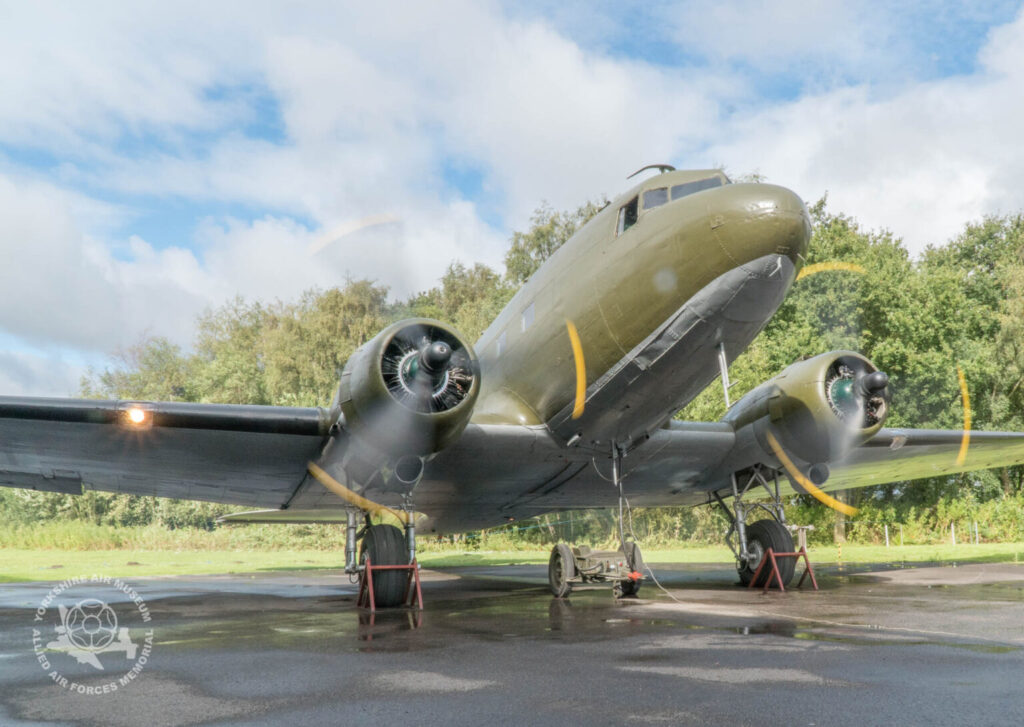
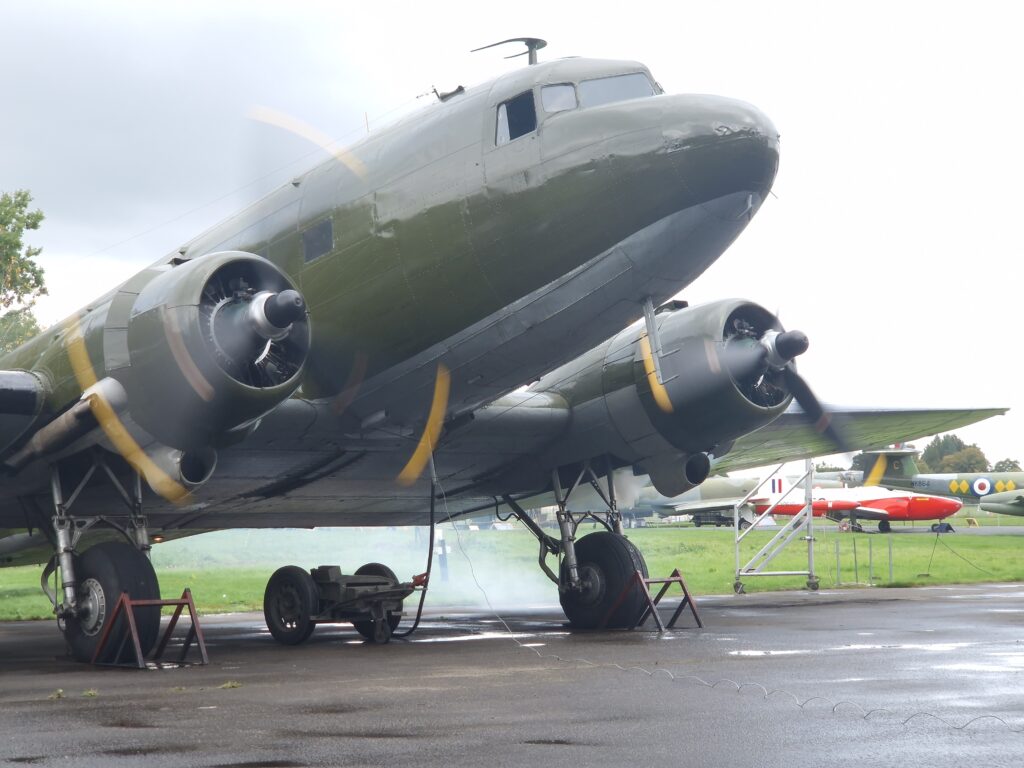
The famous Douglas DC-3 was developed from the DC-2 airliner, powered by two Wright Cyclone engines. It first flew on 17 December 1935. With the US Army Air Force and powered by Pratt & Whitney R-1830 Twin Wasp radial engines, the aircraft was designated the C-47 Skytrain. In RAF service, it was the ‘Dakota’. During the Second World War, C-47 variants flew in many roles from parachute dropping to gunship and the aircraft was renowned for its ruggedness and reliability. A total of 10,655 C-47s were built and hundreds remain airworthy.
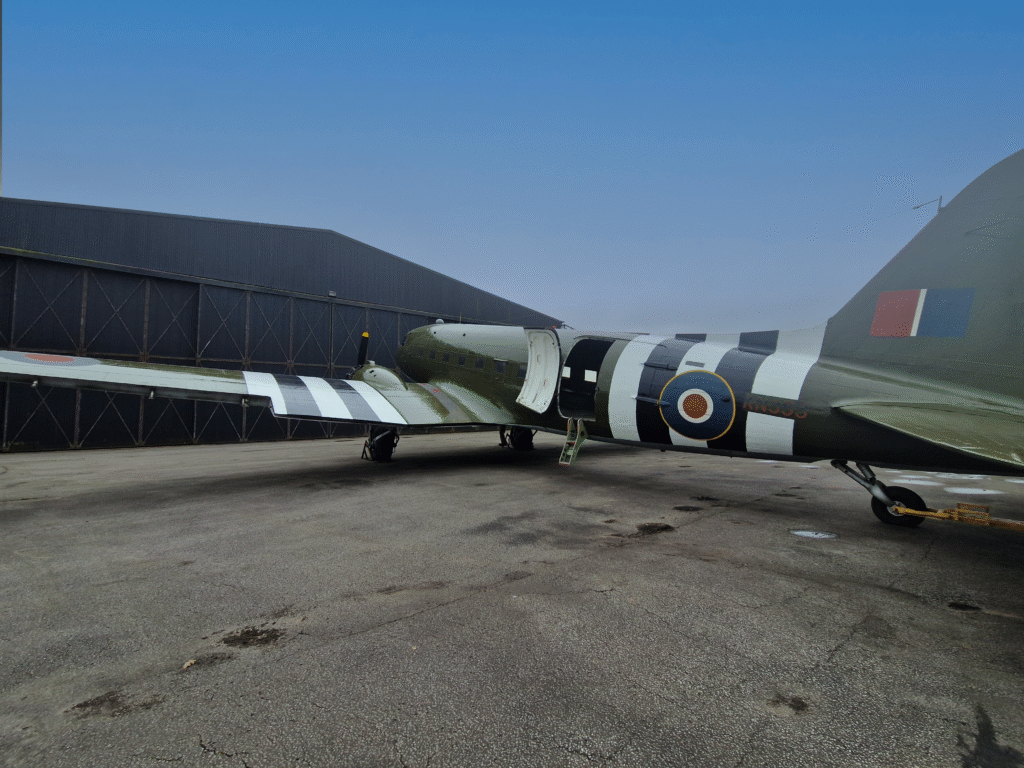
The Museum’s Douglas Dakota IV was manufactured in Oklahoma City, USA, as a C-47B and entered RAF service at RAF Montreal as KN353 in February 1945. In March 1945, it was transferred to 300 Wing in Australia and from May until December 1946 it served in Ceylon (now Sri Lanka) with the ACSEA Communications Unit. From then until October 1947, when it was returned to the UK at 12 MU Kirkbride, it was in the Far East. During transit back to the UK, on final approach at Castel Benito in Libya, the Dakota suffered double engine failure due to a bird strike. The pilot, Flying Officer Alan Thame, landed the aircraft safely in spite of having no engine power and limited vision due to bird remains on the cockpit windows.
In February 1953, the aircraft was bought by Transair Ltd and registered as G-AMYJ. While on a troop-carrying charter with the RAF in 1954 it carried the designation XF747. Subsequently, the Dakota was flown by many small operators, including a spell in Egypt with Nile Delta Services as SU-AZF, until it was bought by Air Atlantique at Coventry Airport for Pollution Control work in the early 1980s. G-AMYJ was used in the television series, “Band of Brothers” about the Airborne D-Day landings.
The aircraft was donated to the Museum by Air Atlantique in December 2001, who especially alluded to the Yorkshire connection – “G-AMYJ” – Amy Johnson.
It was kindly transported to the Museum by Royal Air Force ARTF based at RAF St Athan. Part of the cost of transporting the Dakota to the Museum was met by the Preservation of Industrial and Scientific Material (PRISM) Grant Fund, administered by the Science Museum.
The Dakota has been estensively restored by the Museum’s Aircraft Engineering Department since it has been at the Museum. It has had two new radial engined fitted and is now “operational” and regularly used at the Museum’s “Thunder Days” and special events.
Douglas Dakota 360VR Tour
Take a fascinating virtual look inside our Douglas Dakota. If you’re on a mobile, simply tilt and turn your device. Desktop users, drag and drop to move the view. You can zoom and rotate a full 360 degrees, clicking on the markers will take you to a different section of the plane…