
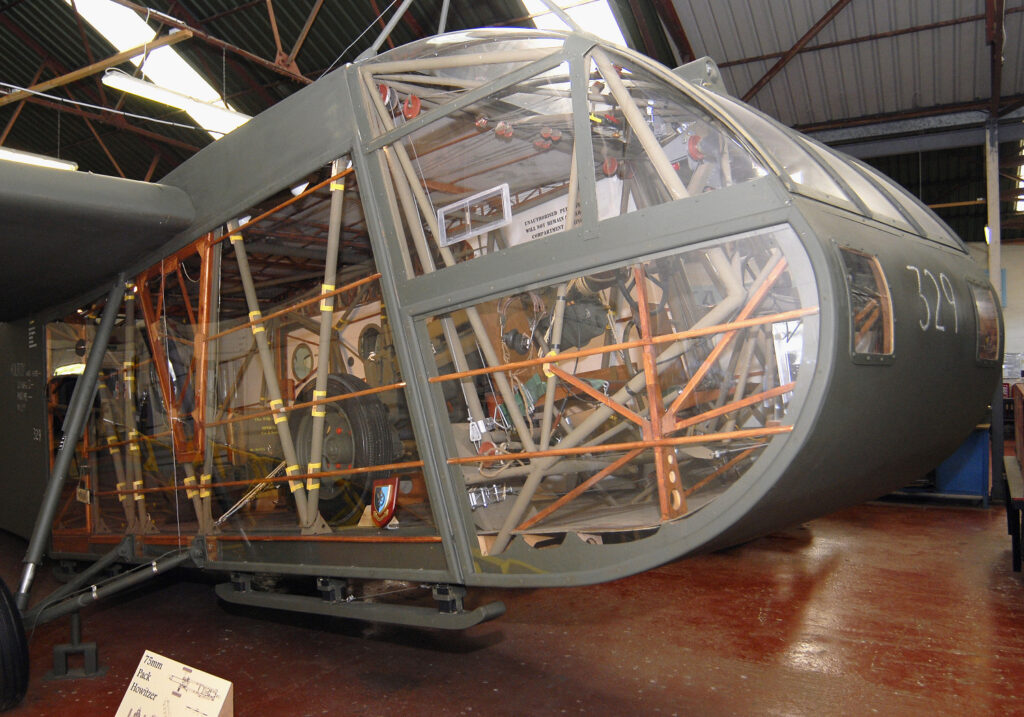
The CG-4A was a wartime troop or cargo-carrying glider made by the Waco Aircraft Company in Ohio, USA. It was named Hadrian when in service with the British forces. It was the only American built troop-carrying glider to be used by the allied forces in the airborne invasions of Sicily and France.
Including the two pilots in the hinged nose, it could carry 15 fully armed troops or a jeep with its crew, or an Army 75 mm howitzer with crew and ammunition. It could carry a total military load of around 3,500 lb and could land in a field 660 feet by 200 feet surrounded by 50 feet obstacles at a loaded stalling speed of 50-60 mph.
The fuselage of the Hadrian was 6 feet 5 inches wide and made of a steel tubular framework covered with fabric on wooden formers with a wooden floor. The wingspan was 83 feet 8 inches and the wings and tail unit were made of wood with a plywood and fabric covering. The training undercarriage consisted of independent wheels, with shock absorbers and hydraulic brakes. The operational undercarriage could be jettisoned by parachute and was a simple cross axle with brake-less wheels. The glider then landed on skids.
The Yorkshire Air Museum’s fuselage is based on an original steel frame and is on display in the main Canadian hangar.