
Many people visiting the Museum today are aware of the fact that French Air Force Squadrons were based here in World War Two. They may also be aware of the name Charles de Gaulle and the critical role he played in the UK which enabled Allied Forces to eventually free France and mainland Europe.
But perhaps many people are unaware of the fast moving pace of events at that historic time in European history, and how de Gaulle found himself in that position and how, but for a twist of fate, events in Europe could have unfolded quite differently. Every year, a special ceremony takes place in a quiet corner of London to commemorate the anniversary of his famous broadcast to the people of France.
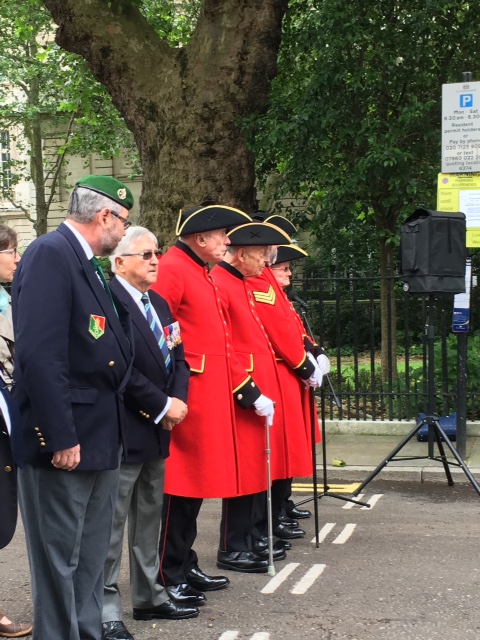
On 18th June 2016 this annual ceremony took place outside General De Gaulle’s Free French wartime headquarters in Carlton Gardens, London SW1. In attendance were the French military and diplomatic staff, British military representatives and a contingent of Chelsea Pensioners, plus French association representatives, children from the Lycée Winston Churchill and the Allied Air Forces Memorial from Elvington. A speech was made by the French Ambassador Sylvie Burmann and wreaths were laid beneath the imposing bronze statue of General De Gaulle.


This is the story of those events of June 1940.
l’Appel (the appeal)
On the 18th June 1940, General de Gaulle spoke to the French people for the first time to ask them to join him in continuing the war. He spoke from London on BBC radio and this single, almost accidental, event is now considered one of the most fundamental acts in French political history.
Since war was declared on 3rd September 1939, both France and Britain had waited with baited breath during what was known as the “Phoney War” until, on 10th May 1940, Hitler’s Panzers and aircraft came streaking through the Ardennes and into France taking the Allies by storm. Stiff resistance and some successes were made by both the British Expeditionary Force and the French Army but the speed, tactics and equipment of the Third Reich gradually overwhelmed them, pushing the British into the Dunkirk pocket where 338,000 allied troops luckily escaped back to Britain between 27th May and 4th June.
On 5th June the French President, Paul Reynaud appointed one of his military advisers, an obscure cavalry officer, Brigadier General Charles de Gaulle, as Under Secretary for Defence. De Gaulle had already scored a significant success against the Germans when he was commander of the French 4th Division but was hardly known either in political or military circles at the time. Four days later he was given the mission to travel to London to ask Churchill for British help to move the French Army to North Africa, where they could continue the war. But events were moving quickly.
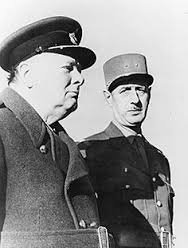
He met Churchill in London, making a strong impression on him, and met him again 2 days later back in France where the Allied War Council met for crisis talks at Briare, south of Paris on 11/12 June and again at Tours on 13th June, where Churchill is said to have again noted De Gaulle’s excellent fighting spirit and whispered that De Gaulle was “l’homme du destin” the man of destiny.
On 14th June with the Germans advancing across France, the French Government fell back to Bordeaux and on the same day German troops marched down the Champs Elysees and under the Arc de Triomphe. The next day Reynaud again sent De Gaulle to London to arrange for war supplies purchased from the U.S.A. by France to be delivered to Britain instead. The situation in France was now rapidly deteriorating and on 16th June, as the most senior representative in Britain on that particular day, De Gaulle was asked by the French diplomatic delegation to help promote a Franco British Union – basically joining the two countries together in order to continue the war as one nation. This remarkable idea did not last long but brought De Gaulle into the centre of the political arena as it became clear that France might fall.
The next day (17th June) he returned to France in a De Haviland DH95 “Flamingo” loaned by Churchill, in a desperate effort to keep France in the War. When he arrived in Bordeaux he found that his friend President Reynaud had been replaced.
Their government was still divided whether or not to fight on. The slaughter in the trenches of the First Wold War, just 20 years previously, was still fresh in the minds of most people and their instinct was that France could not continue the fight against this devastating new warfare called “Blitzkreig”. To create national unity they had elected their hero from the Great War, Marshal Phillipe Pétain, “The Lion of Verdun” then 84 years old.
So, when De Gaulle landed in Bordeaux on 17th June it was already clear cut that France was preparing to surrender to the Germans and end the fighting. He was adamantly against this and made his views well known that he was certain that the Germans could be beaten. It is thought that a warrant for his arrest was already being prepared when, under the guise of saying goodbye to Churchill’s French liaison officer, General Spiers at Merignac air base, he jumped or was pulled, onto the Flamingo as it began to taxi, and flew back to London.
As soon as he landed in London he harried the War Cabinet to be able to broadcast to the French people that very afternoon. At first the Cabinet, then chaired by Neville Chamberlain whilst Churchill prepared his famous “fight on the beaches” speech, refused. There was already a number of other options which the British were pursuing, especially as they had been given to understand that France may still yet withdraw to the south in order to continue the fight. They were not going to offend their ally by allowing a relatively unknown junior politician and soldier to offend the French Government at this crucial stage.
However, General Spears rushed to Churchill and gained his ascent subject to Spears getting the other members of the Cabinet to change their minds. Over the next few hours Spears managed to do this, which was summed up by the Foreign Secretary, Lord Halifax, when he said, “The whole thing is in such confusion that that there seems to me no particular difficulty in hunting several lines at once“.
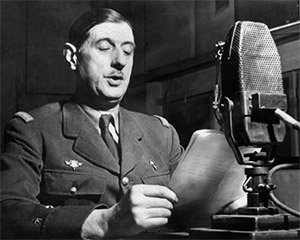
At around 6:30pm De Gaulle made his famous “appeal” to the people of France from BBC Broadcasting House in London on 18th June 1940. His actual “Appel” was hardly heard by anyone in France, but the message it contained grew far beyond the words it contained. De Gaulle offered hope when there was despair, he offered confidence when there was fear and he made a vow to fight on – and win.
3 days later the French Government signed an armistice with the Germans at Compiégne in the same railway carriage used by Marshal Foch to accept the surrender of Germany in 1918. Hitler had it blown up immediately afterwards as a sign of final defeat of the old enemy.
Today we can hardly grasp the fundamental shock which had occured across Europe in just a few days. Over 100,000 French troops, including 2000 airmen had been lost in less than 4 weeks and what we accept today of national character, institutions and liberty was about to be completely extinguished, as France’s leaders called an end to hostilies and acceptance of becoming just a state within the new German Reich.
The British Empire stood alone as most of Western Europe fell under the iron grip of the Nazis, but with this dynamic French soldier on our shores who had the resolution and self belief to call the French nation to his side, there now existed the Free French.
The many accidents and coincidences which brought de Gaulle both to these shores and to prominence at a particular time in our history shows the serendipitous nature of life.
The road to the liberation of France was to be rocky and De Gaulle was never known to be particularly fond of the Anglo-Saxon viewpoint. His relationship with Churchill was particularly difficult although it is plain that they both greatly respected one another and as a pragmatist, De Gaulle knew that he needed Britain by his side and said so.
To sum up his personal attitude he was once asked by Churchill’s wife, “General, you must not hate your friends more than you hate your enemies“, De Gaulle replied “France has no friends, only interests.”
Although the “Appel” was a clear political necessity by those who wished to continue the fight to liberate France and regain her self respect, it has now grown to represent a slightly different memory, that of the beginning of a different kind of government for France and also a very special Anglo/French historical event which defines our joint history, culture and closer friendship.
Ian Reed
Read more at: http://www.brainyquote.com/quotes/quotes/c/charlesdeg111700.html