
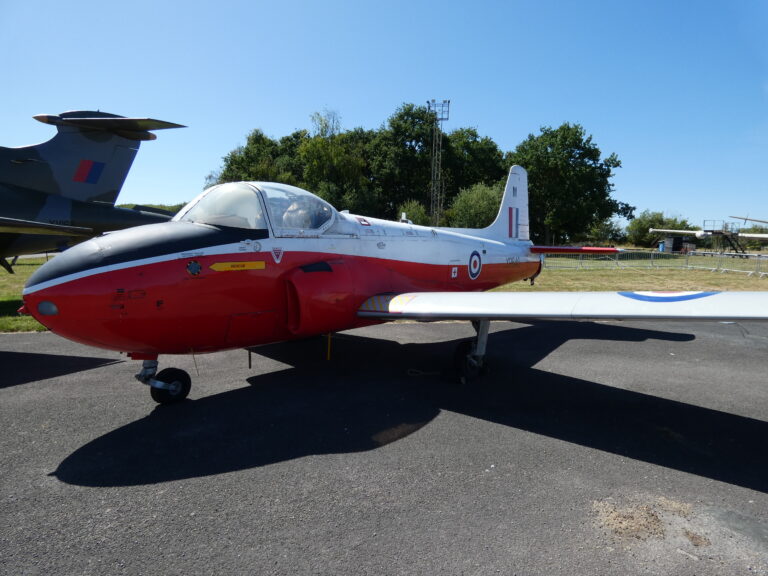
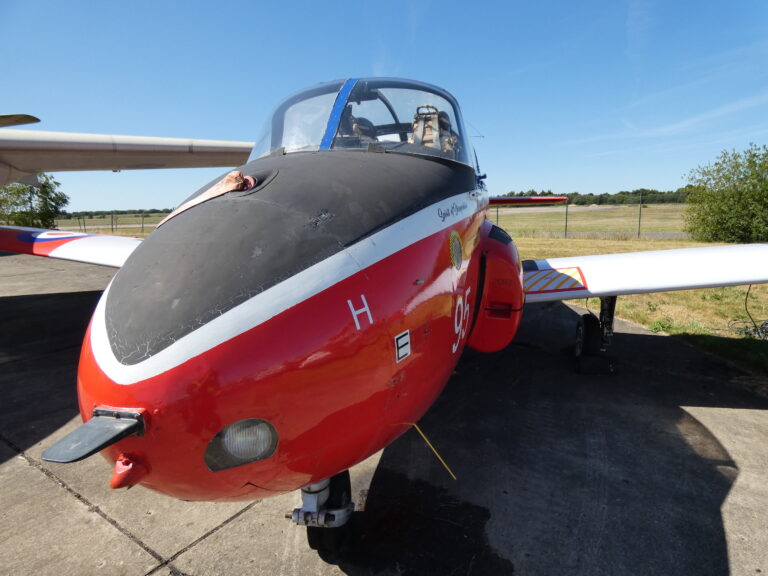

The prototype Jet Provost T.1 was developed from the Piston Provost as an initial jet trainer and first flew on 26 June 1954. After trials, it went to No. 2 Flying Training School at Hullavington for the first all-through (Jet Provost to Vampire) jet flying training course. The T.3 was the basic trainer for the Royal Air Force until the mid-1970s, when the up-graded T.4 was introduced. Development continued to the T.5 and T.5A, which were used for training pilots selected for ‘fast jets’, like the Tornado, Jaguar, Buccaneer and Harrier.
The Jet Provost is a dual-control, single-engined aircraft, with the instructor sitting alongside the pupil. It is powered by an Armstrong Siddeley Viper engine.
The Museum has two Jet Provosts – a T.3 and T.4.
The T.3 flew from Church Fenton near Leeds and was acquired by the Museum in 2022 from Sleap Airfield in Shropshire.
The T.4 is displayed in the colours of No. 6 Flying Training School at Finningley, where it served during the 1970s. It came to YAM in 1993.
The Blackburn Mercury Monoplane is regarded as the first truly successful aircraft made by Blackburn at their factory in Leeds. The Mercury I, powered by a 50 hp Isaacson radial engine, was displayed at the Olympia Aero Show in March 1911 and made its debut flying from the beach at Filey with the newly formed Blackburn Flying School. In May 1911, it flew from Filey to Scarborough and back in 19 minutes at an average speed of 50 mph, reaching an altitude of 1200 feet.
This aircraft crashed the next day when the engine seized and the propeller flew off! The Mercury I was followed by two Mercury II aircraft powered by 50 hp Gnome engines, and six Mercury III aircraft, with a number of different engines. Sadly, a Renault powered Mercury crashed at Filey in December 1911, killing an instructor and passenger.
The Museum’s replica was built for Yorkshire Television in 1979 for the Edwardian drama series ‘Flambards’, and was taxied with a car engine. It came to YAM on 10th January 1995 and after a long period in storage it was painstakingly restored to a superb display standard, and was unveiled in June 2000 by Professor Robert Blackburn, grandson of Robert Blackburn, the aviation pioneer.
The Avro 504 first flew in 1913. In the opening phases of the First World War, it served with front-line squadrons in the Royal Flying Corps and Royal Naval Air Service for bombing and reconnaissance, but from 1915 onwards the aircraft entered the training role for which it is most celebrated.
Over 8,000 Avro 504s were built. In 1918, the Royal Air Force had about 3,000, of which 2,276 were trainers.
The Avro 504 was stationed at many Yorkshire airfields, including Tadcaster near the A1/A64 junction, where a period hangar can still be seen.
The Yorkshire Air Museum’s replica was built by apprentices at RAF Halton and appeared at the Royal Tournament in 1968 to commemorate what was then fifty years since the end of the First World War. The aircraft was refurbished in early 2015 to be transported to Thiepval, Northern France, for the Somme Centenary commemoration event, on request of the British Government. In May 2018, it was also displayed at the impressive Hotel Les Invalides in central Paris for a joint RAF / French Air Force event to mark the Centenary of the Royal Air Force and over 100 years of British and French Air Force collaboration.