Shackleton Engines Arrive

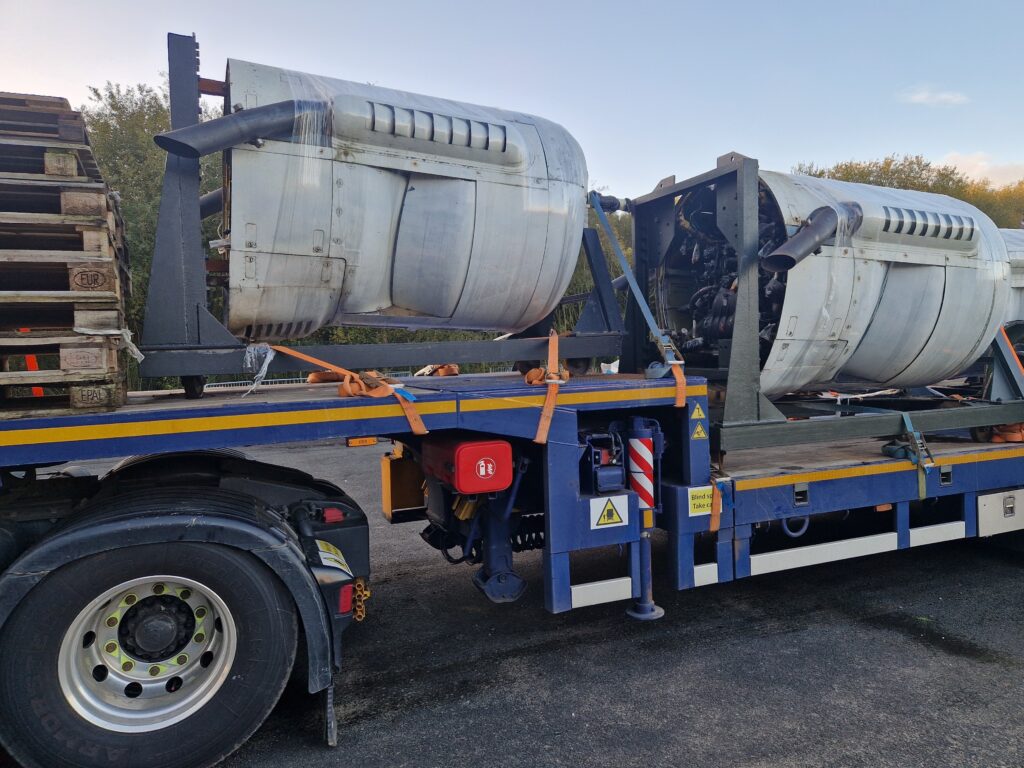
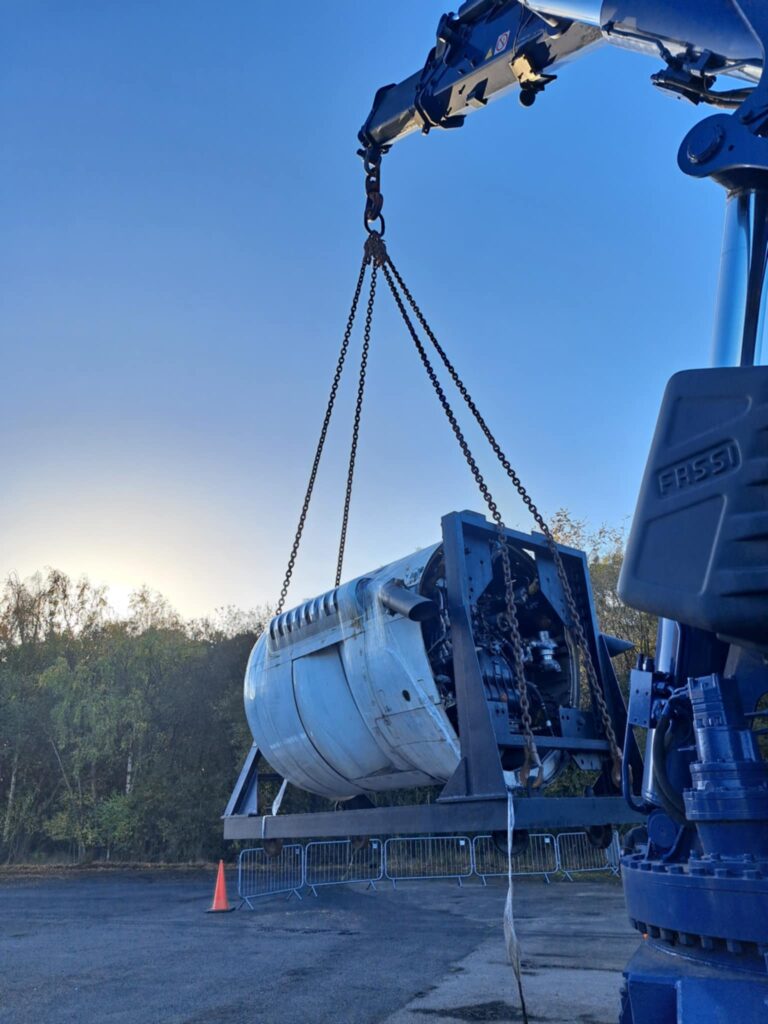
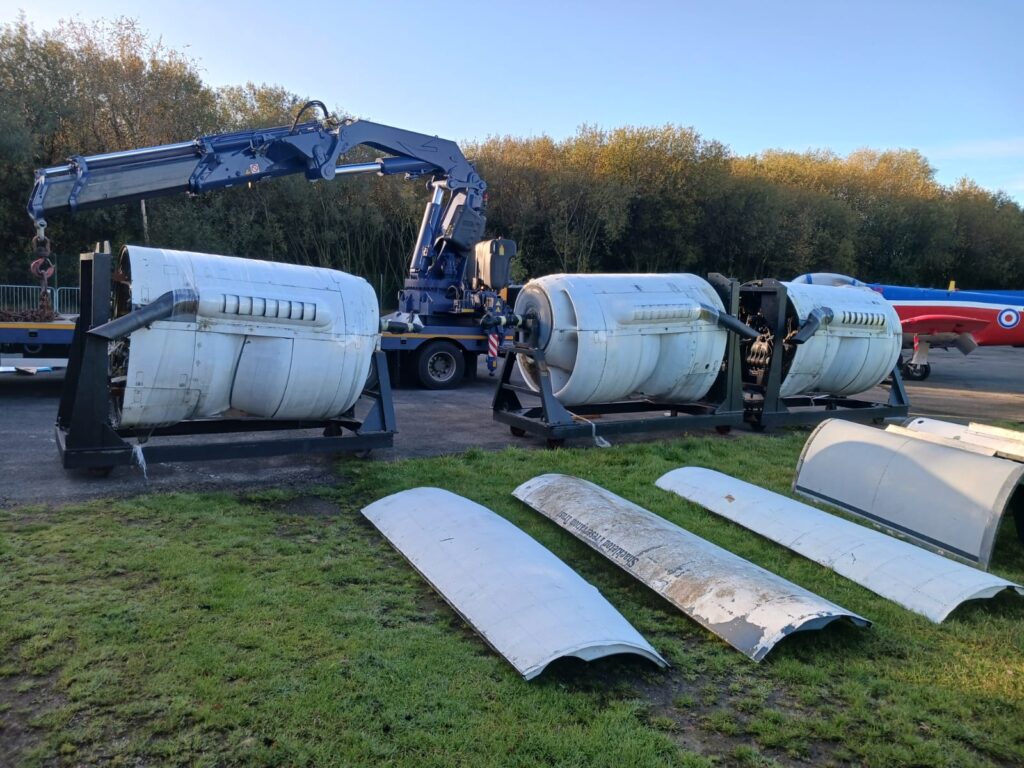
The first pieces of an enormous aviation jigsaw puzzle have arrived at the Yorkshire Air Museum, in the form of Griffon engines for an iconic submarine-hunting aircraft.
Avro Shackleton WR963 is being transferred from its current home at Coventry airport to the museum at Elvington near York, as the Coventry site is due to close.
The aircraft doesn’t fly but its engines do run.
The Shackleton, a four-engined relative of the famous Lancaster bomber, is too large to move in one go, so it’s having to be dismantled, and the parts despatched north in stages.
The first components to arrive at Elvington are three of the four massive Rolls Royce Griffon engines, each producing two and a half thousand horsepower (by comparison a typical family car produces around one hundred).
They were delivered on the back of a lorry today (October 22nd).
The engines alone are so large that all four would not fit on the articulated lorry – one will travel up later.
The rest of the Shackleton will arrive at the Yorkshire Air Museum in stages over coming weeks, until all the parts are on site before Christmas. Work will then begin to put the pieces back together and this is expected to last into 2026.
The goal is to have all four engines up and running again, to be able to run at the Museum in front of the public.
Rich Woods from the Shackleton Aviation Group, which has been caring for WR963 at Coventry said:
‘After a year of hard work, fighting bad weather and corrosion from 30 years of being sat on an exposed area of Coventry Airport, my team and I are delighted that WR963 is now beginning her move north into well-deserved preservation. It’s sad to see the Griffons depart, but comforting to know they’ll run again at YAM, and in such good company.’
Jerry Ibbotson, Yorkshire Air Museum Communications Manager, said:
‘This is a very exciting day. This is an enormous, highly complex jigsaw puzzle and the Griffons are the first of many parts. The Coventry crew have done an amazing job taking the Shackleton apart and they will continue to have a huge role in putting it back together.
For now, we’re overjoyed at seeing the engines arrive and can’t wait for the next deliveries to make their way to Elvington. This is an iconic aircraft that patrolled the skies above British waters, searching for Soviet vessels above and below the surface, as well as playing a vital role in search and rescue operations. To have her here is a real joy’
Notes:
The Griffon was the last piston engine produced by Rolls Royce and the last in front line RAF service, retiring in 1991. Notably an ex-Shackleton Griffon was the powerplant in the world airspeed record holding RB-51 Mustang “Red Baron”.

If you are a journalist and require more info about this story don’t hesitate to email pr@yorkshireairmuseum.org

Blackburn Mercury Monoplane 1911 (Replica) AH (BAPC) 130 YAM Jan.1995

The Blackburn Mercury Monoplane is regarded as the first truly successful aircraft made by Blackburn at their factory in Leeds. The Mercury I, powered by a 50 hp Isaacson radial engine, was displayed at the Olympia Aero Show in March 1911 and made its debut flying from the beach at Filey with the newly formed Blackburn Flying School. In May 1911, it flew from Filey to Scarborough and back in 19 minutes at an average speed of 50 mph, reaching an altitude of 1200 feet.
This aircraft crashed the next day when the engine seized and the propeller flew off! The Mercury I was followed by two Mercury II aircraft powered by 50 hp Gnome engines, and six Mercury III aircraft, with a number of different engines. Sadly, a Renault powered Mercury crashed at Filey in December 1911, killing an instructor and passenger.
The Museum’s replica was built for Yorkshire Television in 1979 for the Edwardian drama series ‘Flambards’, and was taxied with a car engine. It came to YAM on 10th January 1995 and after a long period in storage it was painstakingly restored to a superb display standard, and was unveiled in June 2000 by Professor Robert Blackburn, grandson of Robert Blackburn, the aviation pioneer.

AVRO 504K ‘H1968’ (Replica) AH (BAPC) 42 YAM Oct. 1994

The Avro 504 first flew in 1913. In the opening phases of the First World War, it served with front-line squadrons in the Royal Flying Corps and Royal Naval Air Service for bombing and reconnaissance, but from 1915 onwards the aircraft entered the training role for which it is most celebrated.

Over 8,000 Avro 504s were built. In 1918, the Royal Air Force had about 3,000, of which 2,276 were trainers.

The Avro 504 was stationed at many Yorkshire airfields, including Tadcaster near the A1/A64 junction, where a period hangar can still be seen.

The Yorkshire Air Museum’s replica was built by apprentices at RAF Halton and appeared at the Royal Tournament in 1968 to commemorate what was then fifty years since the end of the First World War. The aircraft was refurbished in early 2015 to be transported to Thiepval, Northern France, for the Somme Centenary commemoration event, on request of the British Government. In May 2018, it was also displayed at the impressive Hotel Les Invalides in central Paris for a joint RAF / French Air Force event to mark the Centenary of the Royal Air Force and over 100 years of British and French Air Force collaboration.