The Day The Hindenburg Visited Yorkshire

For anyone visiting The Museum’s new exhibition, Gas Bags to Super Zeppelins, it becomes quite apparent that the terror tactics of being attacked from the air for the first time in history had a profound effect upon the British public. Despite eventually being victorious in shooting down Zeppelins, the large German airships must have left many dark memories. It’s truly remarkable, therefore, that a far more peaceful visit to Yorkshire by none other than the majestic Hindenburg has retained a strong recollection in local history.

Whilst returning from a trans-Atlantic trip to New York in May 1936, the airship crossed over Britain and stopped – over Keighley in the West Riding of Yokshire. This is the only know time when this famous airship bearing the huge 8m high NAZI swasticas in its tail, actually stopped over Britain, and was only a few months before its spectacular explosion in Lakehurst USA.
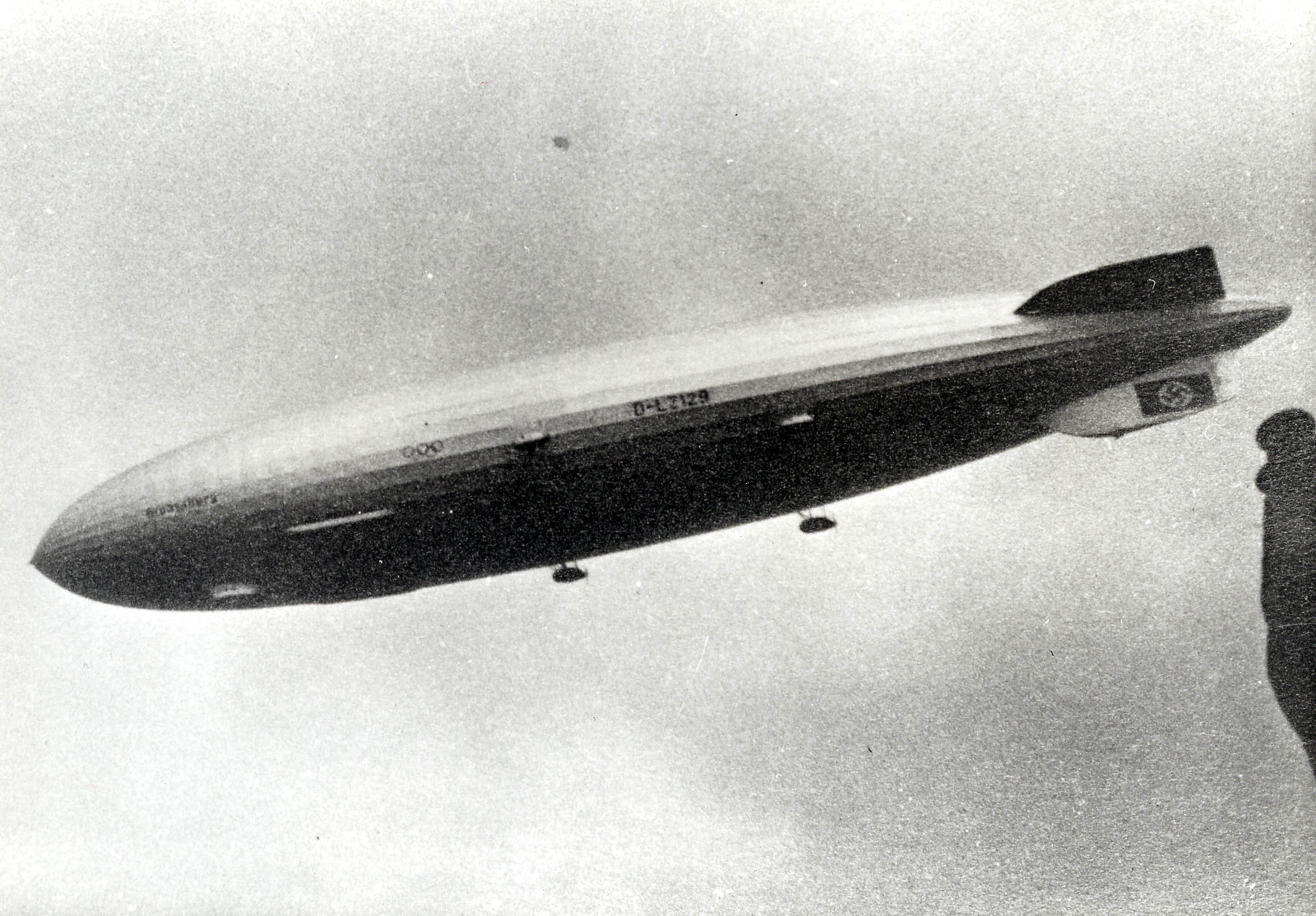
The Hindenburg photographed over Riddlesden

In May 1936, the Hindenburg was returning to Frankfurt in Germany from the USA on one of her scheduled passenger flights, when she changed direction over Yorkshire and descended a significant level in altitude over Keighley.

Her purpose was not to inflict terror, but to drop a parcel containing spray of carnations and a crucifix. On board the Hindenburg that day was John B Schulte, known as the first ‘flying priest’

His brother was buried in the local cemetery in Keighley, having died as a prisoner of war during the Great War. Along with the parcel were some postage stamps and a request to deposit the parcel on his brothers grave.

The dropped parcel was found by two schoolboys, who were filmed by Movietone News completing the Priests wishes.

One of the boys, Jack Gerrard, passed away in 2014 at the grand age of 89. His daughter commented that it was an occasion he never forgot.

Such is the significance of this peaceful gesture that this year, many decades later, the local school in Keighley are also producing a film about the event, to be shown soon.

It is quite fitting in the turmoil of conflict in the 20th Century that the abiding memory of a German Zeppelin over Yorkshire is not one of terror, but one of peace and compassion. The new exhibition at The Museum covers the history of early flight, encompassing the period from the Montgofier Brothers, through the First World War and on to the spectacular passenger airships of the 1930s.

Image via The Telegraph and Argus.

If you are a journalist and require more info about this story don’t hesitate to email pr@yorkshireairmuseum.org

Blackburn Mercury Monoplane 1911 (Replica) AH (BAPC) 130 YAM Jan.1995

The Blackburn Mercury Monoplane is regarded as the first truly successful aircraft made by Blackburn at their factory in Leeds. The Mercury I, powered by a 50 hp Isaacson radial engine, was displayed at the Olympia Aero Show in March 1911 and made its debut flying from the beach at Filey with the newly formed Blackburn Flying School. In May 1911, it flew from Filey to Scarborough and back in 19 minutes at an average speed of 50 mph, reaching an altitude of 1200 feet.
This aircraft crashed the next day when the engine seized and the propeller flew off! The Mercury I was followed by two Mercury II aircraft powered by 50 hp Gnome engines, and six Mercury III aircraft, with a number of different engines. Sadly, a Renault powered Mercury crashed at Filey in December 1911, killing an instructor and passenger.
The Museum’s replica was built for Yorkshire Television in 1979 for the Edwardian drama series ‘Flambards’, and was taxied with a car engine. It came to YAM on 10th January 1995 and after a long period in storage it was painstakingly restored to a superb display standard, and was unveiled in June 2000 by Professor Robert Blackburn, grandson of Robert Blackburn, the aviation pioneer.

AVRO 504K ‘H1968’ (Replica) AH (BAPC) 42 YAM Oct. 1994

The Avro 504 first flew in 1913. In the opening phases of the First World War, it served with front-line squadrons in the Royal Flying Corps and Royal Naval Air Service for bombing and reconnaissance, but from 1915 onwards the aircraft entered the training role for which it is most celebrated.

Over 8,000 Avro 504s were built. In 1918, the Royal Air Force had about 3,000, of which 2,276 were trainers.

The Avro 504 was stationed at many Yorkshire airfields, including Tadcaster near the A1/A64 junction, where a period hangar can still be seen.

The Yorkshire Air Museum’s replica was built by apprentices at RAF Halton and appeared at the Royal Tournament in 1968 to commemorate what was then fifty years since the end of the First World War. The aircraft was refurbished in early 2015 to be transported to Thiepval, Northern France, for the Somme Centenary commemoration event, on request of the British Government. In May 2018, it was also displayed at the impressive Hotel Les Invalides in central Paris for a joint RAF / French Air Force event to mark the Centenary of the Royal Air Force and over 100 years of British and French Air Force collaboration.